Cutting Agent Call Times by 27% Through Redesign
A leading Canadian communications company — mobile, cable, internet, phone — runs a large customer-facing team called Reps. They handle high volumes of calls, chats, and in-store visits every day. When their tools work, service flows. When they don't, customers feel it.

Duration
7 month
My role
Senior UX Designer: end-to-end UX design for high-impact features, research, prototyping, iterative testing
Design team
2 streams, 5 designers
Domain
Telecommunications, Retail
The Beginning: A Maze of Tools
Picture a customer service agent switching between six legacy apps just to help one customer. Repeating steps, hunting for buried information, context-switching constantly. Some agents had built their own handwritten cheat sheets just to get through a shift.
The tools were the problem. Not the agents.
Understanding the Problem
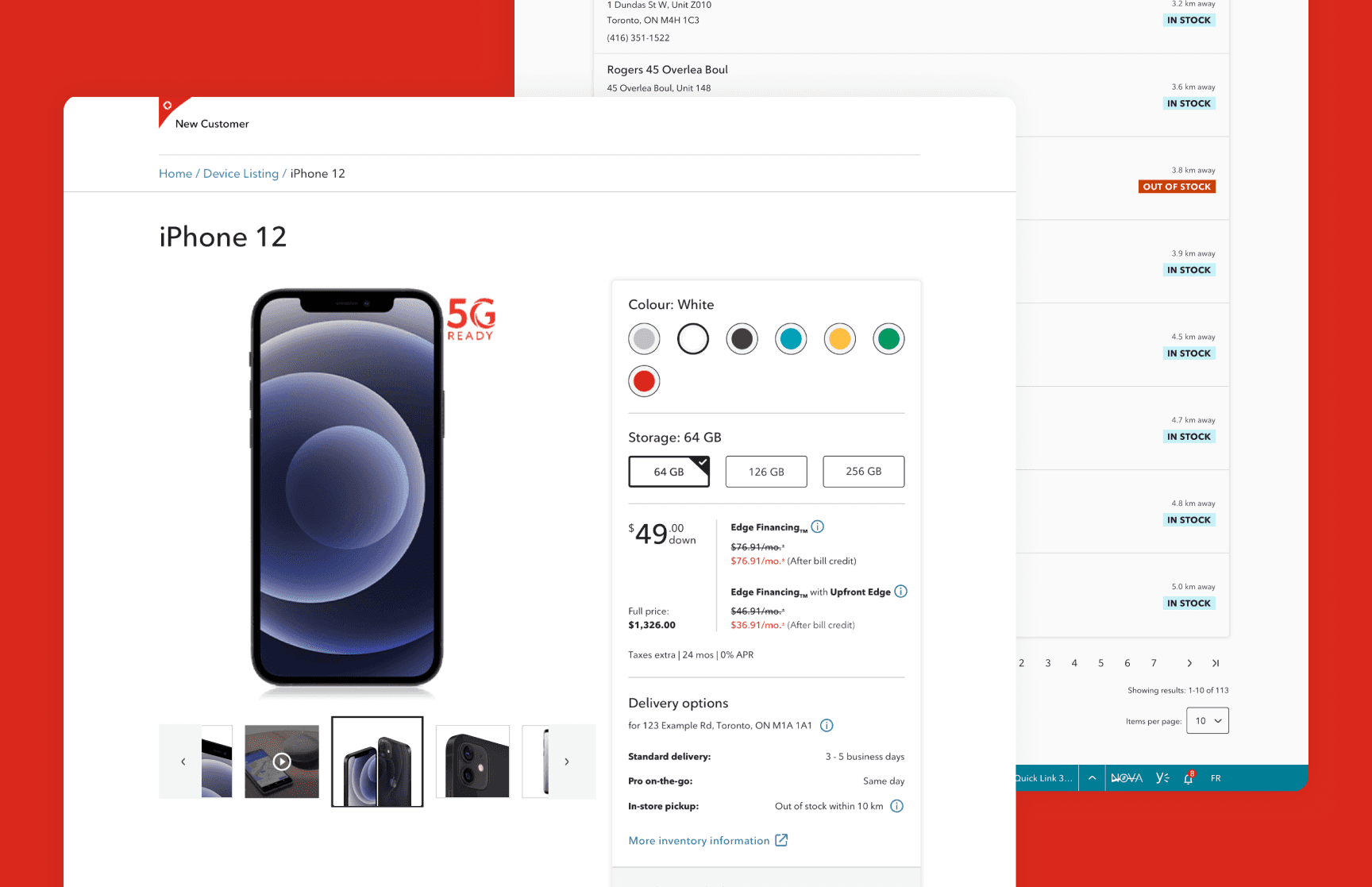
To find the highest-impact areas, I worked closely with the client — reviewing corporate satisfaction surveys and internal data — then went further. I shadowed agents, ran interviews, and mapped their workflows step by step. Three features came up in nearly every interaction: inventory lookup, discount application, and device listing.
What we discovered:
Critical features were buried or invisible. Checking store inventory — essential when a customer wants to buy a phone — was so hard to find that agents regularly skipped it and worked around it.
Repetitive tasks were causing errors. Not from carelessness, but from a system that made simple things unnecessarily complicated.
Agents were constantly context-switching, which meant clear opportunities to consolidate and surface what mattered most.


Designing with Agents
I focused the redesign on three things:
Consolidate the essentials into one system.
Surface critical information immediately.
Add predictive suggestions for common tasks to cut repetitive steps.
Testing ran every two weeks, and it was scrappy by necessity. Corporate tools were locked down, so we improvised — agents shared their screens and walked me through where they'd click. No lab, no formal setup. Just real feedback from people doing the actual work.

Collaboration Across Teams
Redesigning features in a live system with overlapping apps is delicate. Touch one thing, break another. I worked closely with developers, analysts, and fellow designers to map dependencies before touching anything. Coordination wasn't optional — it was the only way to ship without disrupting agents mid-shift.
Seeing the Impact
The results were tangible:
Agent-client call duration dropped by 27% — meaning faster answers for customers, and less time lost to broken workflows.
Repetitive errors decreased. Agents could finally focus on the conversation, not the tools.
Agents reported feeling more confident and in control during high-volume shifts.
And what I kept coming back to wasn't a metric:
“I can finally focus on helping the customer, not fighting the tools.”
We touched a focused subset of features. That was the point. Targeted design on the right problems creates impact that spreads.


Lessons Learned
Focused design beats comprehensive redesign. You don't need to fix everything — you need to fix the right things.