Reinventing the Launch Deck
A global prestige beauty company – dozens of iconic brands, markets worldwide. And a product launch process that was quietly falling apart behind the scenes.

Duration
4 months
My role
Senior UX Designer: co-led discovery, then sole designer from concept through to developer-ready MVP
Design team
Started working with a Lead UX Designer, then continued solo
Domain
Beauty, retail
Why It Mattered
In beauty, almost everything around a product launch runs through one artifact: the stakeholder presentation deck. Get that right and the launch has momentum. Get it wrong and you're spending the week before a major rollout chasing email chains for the latest version.
That was the situation. PowerPoints passed around by email, edits lost, branding inconsistencies slipping through to final review. The presentations weren't supporting launches — they were adding work to them.
I was brought in to change that. Not just cleaner slides — a smarter, scalable workflow across six global brands.
Leading with Research
Together with the lead designer, I co-ran discovery: stakeholder interviews, workshops, and pain point mapping across teams. Working as a pair let us challenge each other's reads on what we were hearing before I took the design work over solo.
Three user groups emerged with clearly different needs:
Editors
Buried in manual formatting, needing templates they could actually trust
Reviewers
Lost in version confusion, needing one current source of truth
Managers
Approving under uncertainty, wanting visibility into progress without more process on top
"We spend more time wrestling with decks than preparing for the launch itself.”
Same pattern across all six brands: the tool meant to support launches had become the obstacle.
From Insights to MVP
Once discovery wrapped, I owned everything. The dev team had already committed to Drupal, which came with real design constraints. I worked within them deliberately — focusing on the flows and components that would deliver the most value inside what was technically feasible.
What I did:
Ran workshops with brand teams to identify the most common deck errors
Turned those errors into standardized, brand-safe templates
Mapped end-to-end flows for all three user groups
Translated every research frustration into a specific, testable design goal
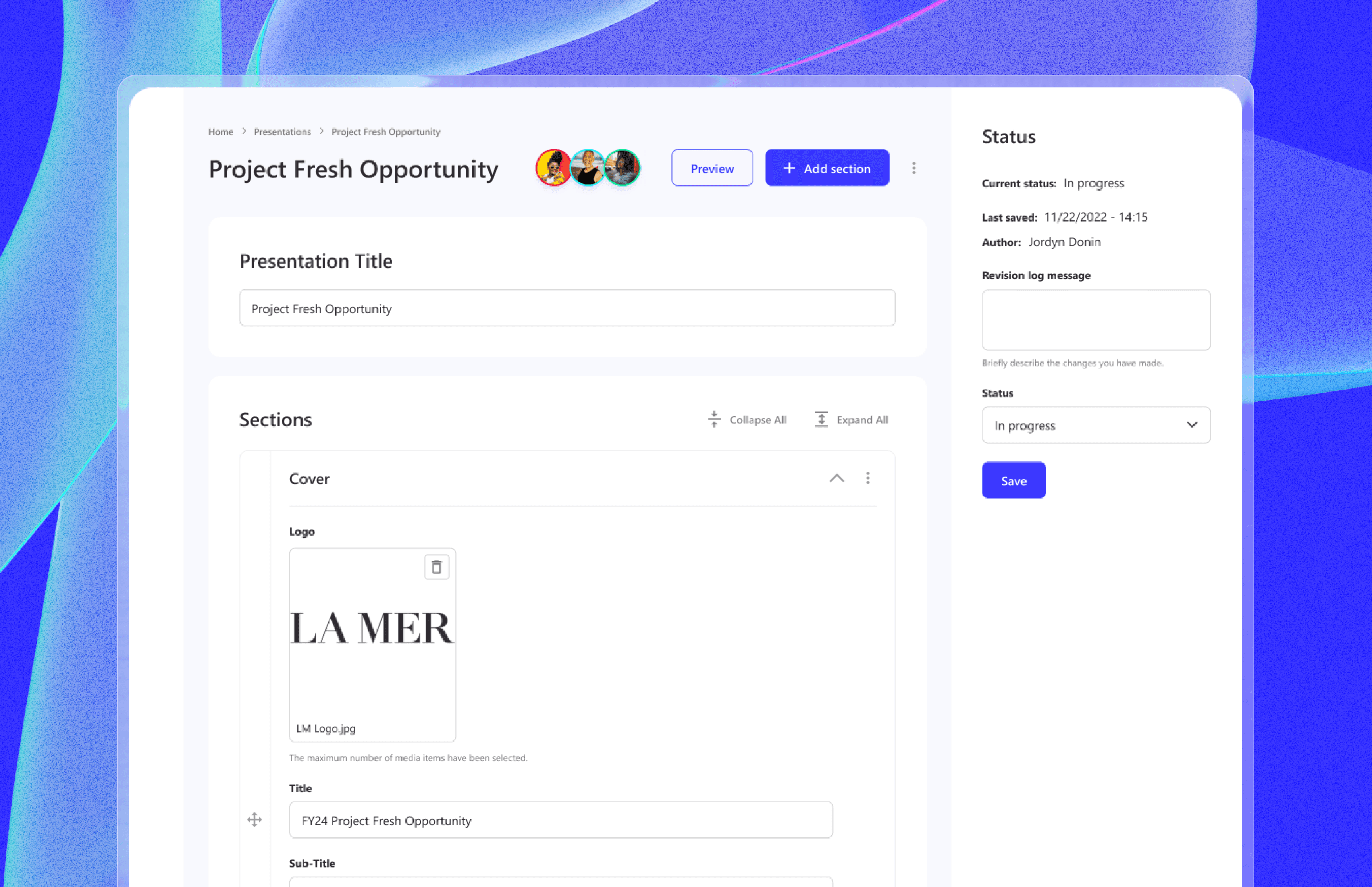
Four months: 20+ screens and a 150+ piece component library across six brand identities, built for reuse and a clean developer handoff. Core flows covered automatic data pull, version control, instant brand theming, and a review and approval process that kept everyone aligned without adding friction.


What Changed
The MVP transformed how teams worked:
Editors stopped losing hours to formatting — focused on content instead.
Reviewers always knew what version they were looking at, and gave feedback faster.
Managers tracked progress without chasing updates.
Decks that had taken days of back-and-forth were done faster, with fewer errors reaching final review.
The component library stuck around after the project closed. Brand teams adopted it as a base for other internal tools — which, more than any metric, told me the system had actually landed.
"It finally feels like the presentation is helping the launch – not holding it back.”



Looking Back
Internal tools rarely get attention. But the people using them are under real pressure at exactly the moments that matter — a launch week, a stakeholder review, a tight deadline. When the tool breaks then, it breaks everything.
Getting that right felt like the job.